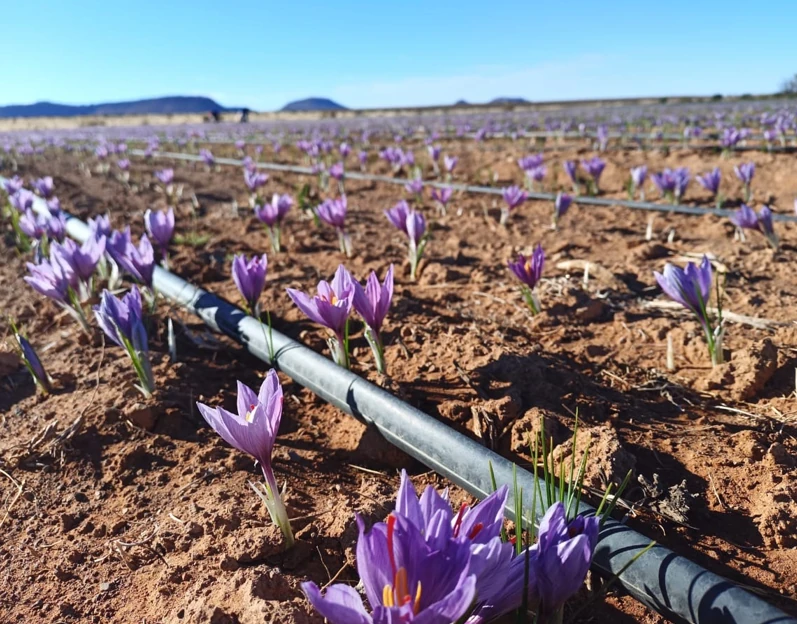
Understand your land. Plan your crop. Know what to expect.
Whether you are considering your first saffron planting or planning a larger commercial operation, understanding your local growing conditions, production requirements and the work involved is essential.
A successful saffron crop depends on more than planting good-quality corms. Climate, soil, drainage, water availability and crop management all influence how the plants establish and perform.
A successful saffron crop depends on more than planting good-quality corms. Climate, soil, drainage, water availability and crop management all influence how the plants establish and perform.
Saffron suits a seasonal growing cycle with cool growing months and a dry dormant period. Some summer-rainfall locations can support cultivation where temperature patterns, rainfall distribution and drainage are suitable. A region’s name alone does not establish whether a particular site will work.
Saffricon uses autumn cooling towards approximately 25°C by day and 10°C at night during March, or by mid-April, as a local planning reference. Further cooling during April and May supports the flowering period. Use local temperature records and discuss your site with the team; these figures are not a guarantee of flowering or a pass/fail test for a farm.
Well-drained sandy loam is preferred. Saffricon’s site assessment considers a clay content below 20%, together with soil analysis and drainage. Prolonged moisture during summer dormancy increases the risk of corm rot. Established plants can tolerate cold, but flowers need care during freezing or snowy conditions.
Before planting
Before committing to a planting, consider your location, climate, soil, drainage and water supply. Discuss your site with the Saffricon team so that its general suitability can be considered before proceeding.
For growers choosing the Trial Pack, ITEST™ Soil Analysis is included after purchase, together with the associated growing guidance and fertilisation programme. This provides a practical starting point for assessing the soil and planning the initial planting.
Growers planning a larger commercial planting can discuss their site, corm requirements and supply arrangements directly with Saffricon. A Trial Pack is an option, not a requirement for purchasing bulk corms.
Plan around a growing season.
In South Africa, the growing cycle typically runs from March to October. Flowering typically occurs approximately 40 days after planting, usually during April and May. Following flowering, foliage and daughter corms develop through winter before summer dormancy towards the end of October. Agree site preparation and planting timing with the team. Site conditions, corm condition and management influence crop development.
March Planting and establishment
April–May Flowering and harvest
Winter Foliage and daughter corm growth
Late October Summer dormancy begins
Make room for the work.
Saffron cultivation involves more than planting and waiting for flowers. Flower picking takes place over a relatively short period and needs to be followed by careful stigma separation, drying and handling to preserve quality. Prepare access to the planting area, people to help with flower picking, time for stigma separation and a clean handling and drying area. Ongoing weed management, irrigation and crop monitoring also need to fit your routine. Labour availability and the ability to handle freshly harvested flowers promptly are particularly important when planning a larger planting.
Budget beyond the corms.
Corms are only one part of the investment required to establish and manage a saffron crop. Budget for land and plot preparation, water supply and irrigation where needed, labour for planting, crop maintenance and harvesting, basic tools and equipment, flower handling and drying facilities, and plant nutrition and other inputs. The overall investment depends on the planting size, local conditions and resources already available. International freight, export arrangements and destination-country import requirements are quoted separately. See current Trial Pack pricing and payment options →
Measure before you scale
Whether you are starting small or already operating commercially, keep accurate production records to understand crop performance and make informed decisions.
Whether you are starting small or already operating commercially, keep accurate production records to understand crop performance and make informed decisions.
Record the planting date, corm quantity, grade and plot area.
Keep a log of water, inputs, observations and labour hours.
Record flower numbers, harvested saffron weight and handling methods.
Discuss quality and analysis results, not just the amount harvested.
Use actual production results and costs to assess performance and guide future planting decisions. Harvest weight alone does not provide a complete picture of profitability.
Consider the risks before a large investment
A large commercial saffron planting represents a significant investment in corms, land preparation, irrigation, labour and ongoing crop management. Without testing under your own conditions, there is greater uncertainty around establishment, flowering, corm development, disease risks and crop management. Results from one region cannot automatically be expected in another.
A smaller trial can provide practical experience and help assess your site before a larger investment. Growers ready to proceed commercially can discuss their requirements and bulk corm supply directly with Saffricon. The decision to start with a trial or proceed with a larger planting remains yours.
Understand the commercial arrangements
A high selling price per kilogram is not the same as farm profit. You own your corms and manage cultivation independently. Saffricon does not buy back saffron corms. Buying corms does not guarantee a market for your harvest. Harvest purchases are considered separately and are subject to a delivery agreement, acceptance and the required ISO quality grading. A Trial Pack does not establish a guaranteed yield, multiplication rate or income. Discuss the commercial arrangements before making investment decisions.
This is an introduction to planning a saffron planting. Your supplied planting instructions and site-specific advice guide the actual cultivation programme.
Saffricon specialises in outdoor, in-ground cultivation. It does not provide technical support or growing guidance for indoor or greenhouse production systems. You can still discuss corm supply for those systems.
Before you order
Ready to take the next step?
Review the relevant product, support and ordering information before placing your order.
Acknowledgement of receipt of the Saffron Grower’s Manual
Saffricon (PTY)Ltd has developed a detailed Saffron Grower’s Manual that contains trade secrets and other confidential information that is integral to the successful operations of the company’s business.
A copy of the Saffron Grower’s Manual is being made available on loan forthwith referred to as the trial grower to assist him/her in the operation of the business.
The Saffron Grower’s Manual remains the property of Saffricon (PTY)Ltd and it is noted that the copy of the Saffron Grower’s Manual has been entrusted to the trial grower.
The Saffron Grower’s Manual and any supplementary manuals or related documentation is/are made available to the trial grower on the express condition that it shall not, by way of trade or otherwise, be lent, sold, hired out or otherwise circulated or distributed to anyone without Saffricon (PTY)Ltd prior written consent. This includes copies in both printed and electronic format.
The trial grower acknowledges that he/she has been expressly requested to keep the Saffron Grower’s Manual confidential not to make copies of the Saffron Grower’s Manual.